Description
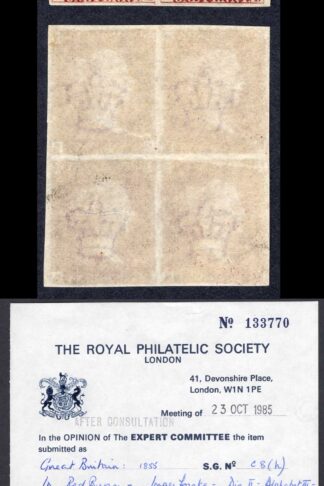
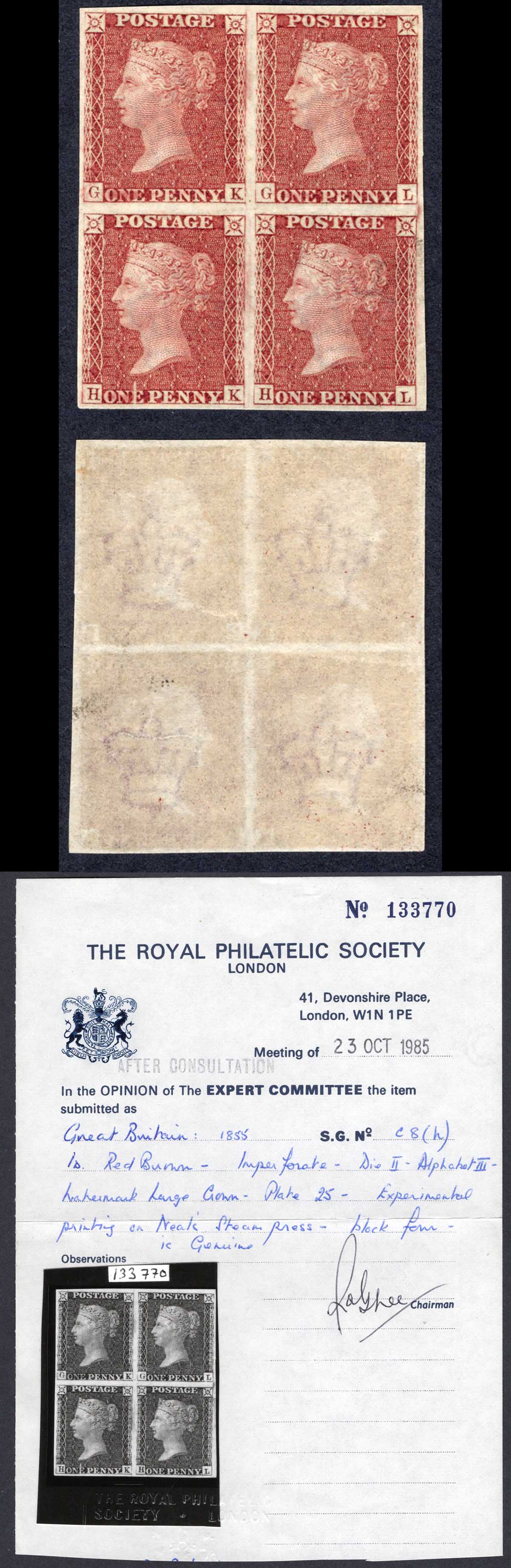
Great Britain 1855 1d red brown Plate 25 (Neals Steam Press Experimental Printing) SG29a. A very fine and fresh unused imperforate block of four lettered GK-HL. (GK and HK both have Gothic Ks). A lovely multiple without any of the usual heavy creasing as normally seen on this failed experimental printing. GP Specialised Catalogue No C8(1)h. Accompanied with a 1985 Royal Philatelic Society (RPS) Certificate of Authenticity. Very rare as only a half sheet of imperforate stamps from the different shade of plate 25 exist with most being in poor condition. SG Catalogue Value 12000 pounds. The Failed Experiment. Between 1854 and 1856 the Board of Inland Revenue and stamp printers Perkins Bacon permitted American engineer-inventor Robert Neale to test his steam-powered printing press. The goal was to replace traditional hand operated presses to accelerate production to meet the skyrocketing demands of the post office. However the experiment encountered significant structural problems ie Severe Creasing. The immense uneven mechanics and rapid sheet-handling systems of Neales press routinely buckled the damp security paper leaving the few surviving examples heavily creased or severely folded. Ungummed and Imperforate Trials Because these sheets were run purely as mechanical test trials they were left unperforated and predominantly lacked the standard gum backing Ultimately the trials were deemed quite unsatisfactory the project was abandoned and Perkins Bacon returned to reliable hand-press production. The Plate 25 Mystery and Rarity While the primary August 15 1855 trial run utilised Plate 22 (resulting in an intact sheet that was later broken up for collectors) a minute fraction of imperforate material emerged from Plate 25. The pedigree of this specific stamp block traces back to a half-sheet discovered in New York in 1939 which featured a distinctly different shade from the common runs and was later meticulously cut into smaller philatelic units. Because Plate 25 was not officially put to press for regular postal duties until November 1855 it has historically sparked rigorous scholarly debate within the Royal Philatelic Society regarding whether it stemmed from a secondary unrecorded leg of Neales trials or an irregular imperforate printing anomaly. The consensus remains that it belongs to this highly scarce experimental bracket. Condition Authentication Factors Finding any Neales Press trial block in very fine and fresh unused condition without the mandatory structural paper creasing is extraordinarily difficult. Most known specimens are fractured heavily creased space fillers or singles. A multiple of four containing four full margins is of the scarcest pedigree. This is not to be confused with the much commoner plate 22.